
The Tipping Escalation Ladder (Part 1 of 3)
TL;DR
Tipping is evolving. What once rewarded exceptional service is increasingly shaped by payment prompts, social pressure and platform design.
The Tipping Escalation Ladder describes this shift:
Optional → Suggested → Expected → Engineered → Social Penalty.
As tipping becomes embedded in payment systems and delivery apps, the line between voluntary gratitude and engineered expectation is becoming increasingly blurred.
How Optional Gratitude Becomes Engineered Expectation
“Stay home if you can’t afford to tip.”
That was one of the responses I saw in an online discussion about tipping at a Caribbean resort. The comment wasn’t unusual. In fact, it was one of many passionate replies in a thread debating whether tourists should always tip, and how much.
What struck me wasn’t the disagreement itself. It was how strongly people now feel about tipping.
Tipping used to be simple. A small gesture to thank someone who had provided genuinely exceptional service.
Today, it feels different.
After returning from my first proper holiday in nearly nine years, I found myself reflecting on how tipping seems to be evolving, particularly in tourist destinations and increasingly back home in the UK.
The Hidden Subsidy
There is another dimension to tipping that often goes unspoken.
When customers tip, they are effectively contributing directly to staff wages.
On the surface this looks like generosity. Economically it creates a different dynamic.
If customers regularly supplement wages, businesses face less pressure to increase those wages themselves. Some critics argue that tipping systems can even allow wages to stagnate while staff are expected to rely increasingly on customer generosity. Whether tipping directly suppresses wages is debated, but the incentive structure raises an uncomfortable question: if customers routinely bridge the gap, how strong is the pressure on employers to close it themselves?
Over time, part of the payroll quietly shifts from the employer to the customer.
Whether intentional or not, the result can be the same: labour costs are partially outsourced to the people buying the service.
This doesn’t happen overnight. It tends to evolve gradually.
And that evolution often follows a familiar pattern.
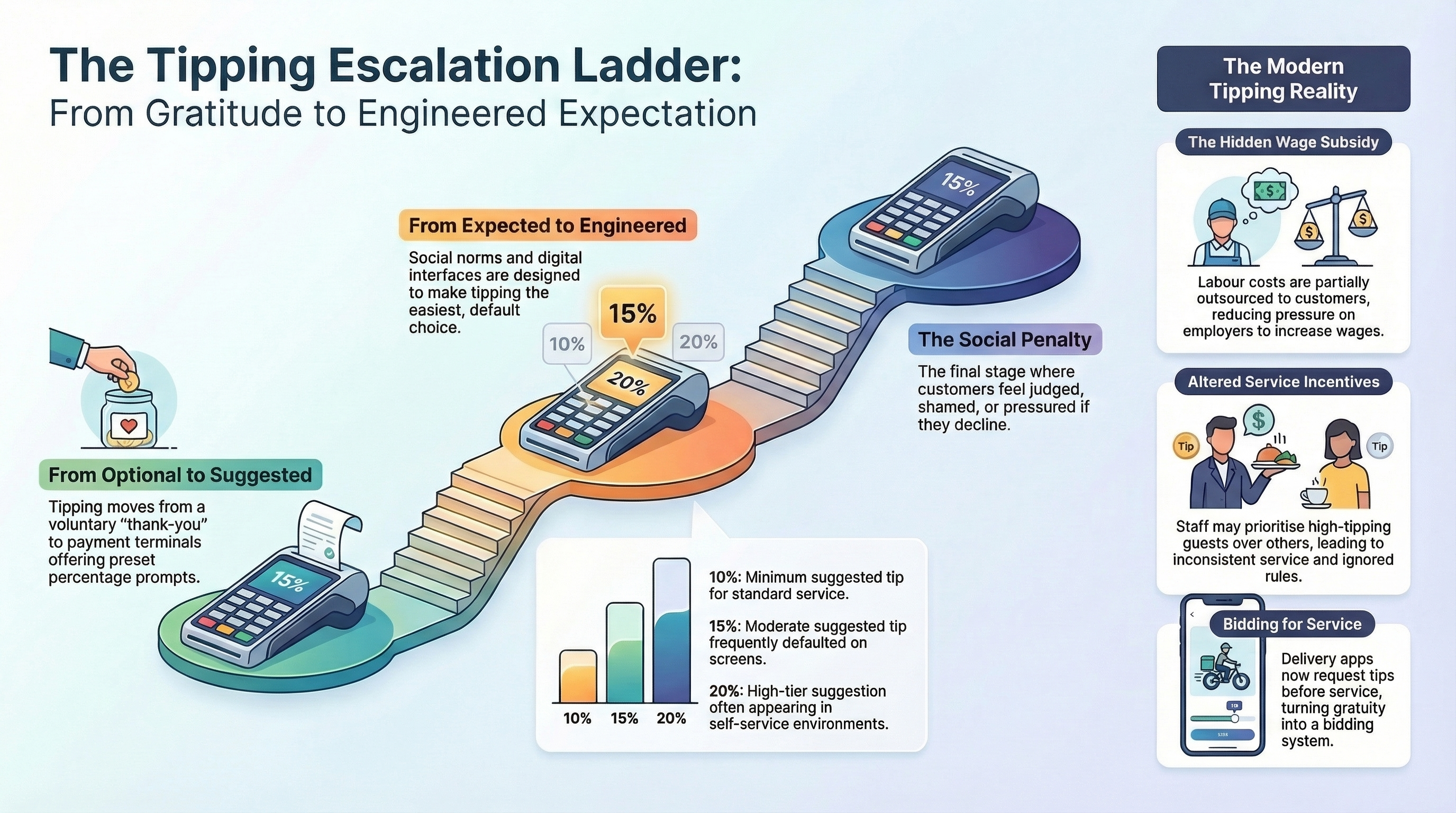
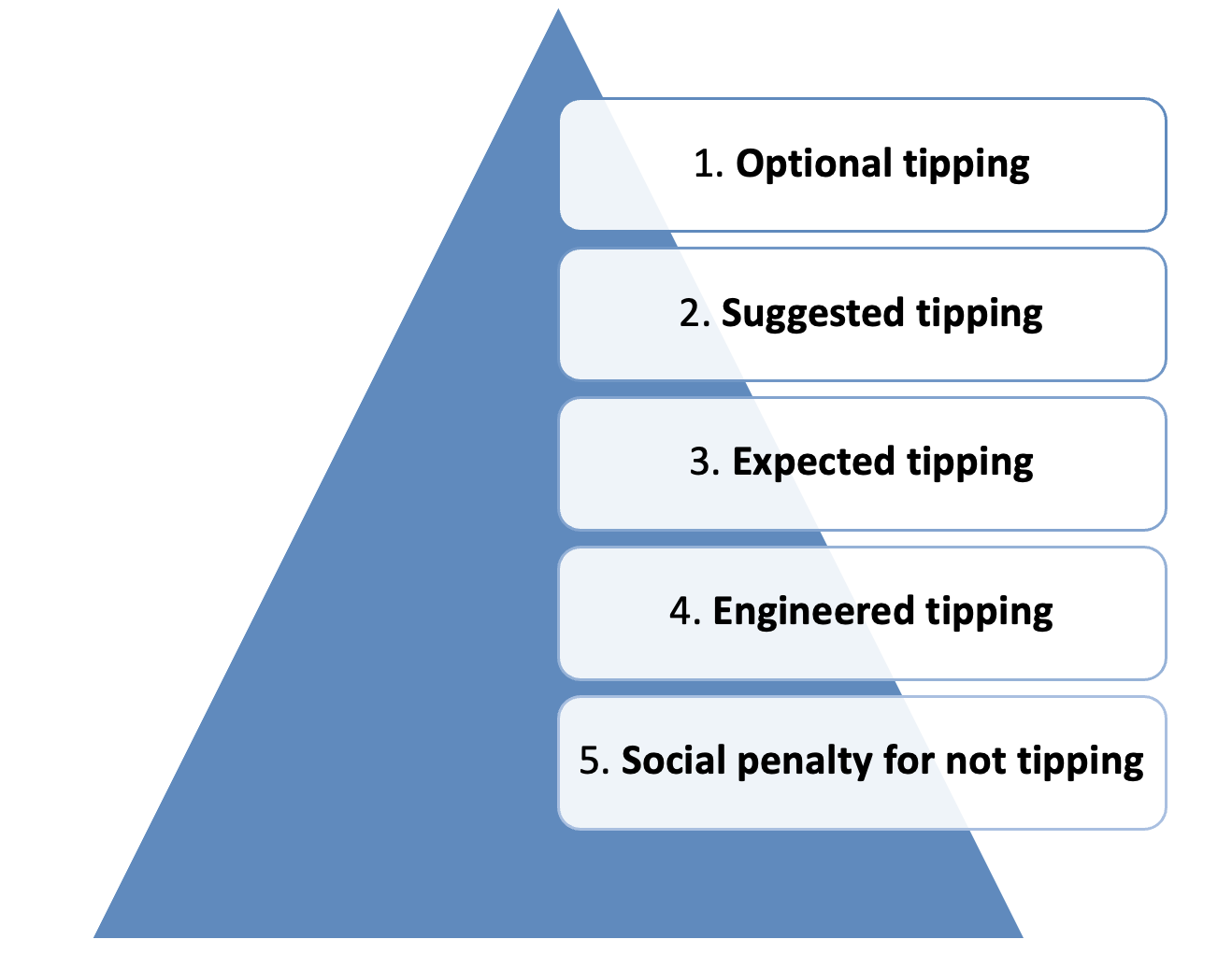
The Escalation of Tipping
- Optional tipping
- A voluntary thank-you for exceptional service.
- Suggested tipping
- Payment terminals begin offering preset percentages.
- Expected tipping
- Social norms signal that tipping is standard practice.
- Engineered tipping
- Interfaces and payment systems are designed so tipping becomes the easiest option.
- Social penalty for not tipping
- Customers feel judged, shamed, or pressured if they decline.
Looking around today, it increasingly feels as though the UK is somewhere between stages three and four.
When “All Inclusive” Isn’t Really All Inclusive
Nine years ago, on a similar holiday, I remember seeing a sign at the resort explaining that staff were paid and that tipping was entirely optional.
That message has quietly disappeared.
In its place are tip boxes, envelopes and subtle expectations.
Nothing explicitly mandatory… but enough signals to suggest that tipping has become part of the experience.
When you’ve already paid the premium for an all-inclusive holiday, the idea that you’re expected to keep supplementing wages throughout your stay begins to feel contradictory.
Either the service is included, or it isn’t.
Incentives Change Behaviour
One thing became clear during the trip: tipping doesn’t just affect income, it changes behaviour.
Staff understandably gravitate towards guests who tip regularly. Guests waving cash at the bar can receive faster service. Large groups behaving loudly or rudely may be indulged because they represent the potential for larger gratuities.
Meanwhile quieter, respectful guests sometimes find themselves waiting longer.
Rules can also become flexible.
In one restaurant clearly marked as no smoking or vaping, guests were openly vaping at the table. Staff looked uncomfortable but said nothing. The reluctance to challenge behaviour was noticeable… confronting a guest risks offending someone who might otherwise leave a tip.
The Cultural Clash
Part of the tension comes from the collision of different economic systems.
In the United States, tipping is deeply embedded in the hospitality industry. Service workers often rely on tips as a significant part of their income.
In the UK and much of Europe, the model is different. Staff wages are expected to be paid by the employer, and tipping is generally seen as a bonus rather than an obligation.
Neither system is inherently right or wrong. But when those expectations meet in international tourism, misunderstandings are inevitable.
For some travellers, tipping is a moral obligation.
For others, it remains a voluntary gesture.
And when those perspectives collide, friction follows.
The Transparency Problem
One argument often made in favour of tipping is that it keeps food and drink prices lower.
But this logic begins to break down when tipping systems appear in places where prices have not fallen.
Across the UK it is becoming increasingly common to encounter payment terminals that default to suggested tips of 10%, 15% or even 20%. Sometimes the option for 0% is hidden behind additional prompts.
More surprisingly, these prompts are now appearing in environments that are effectively self-service.
At that point, it raises a simple question:
What exactly is being tipped?
If service costs are rising, perhaps the most honest approach would simply be to include them in the advertised price.
Where Do Tips Actually Go?
Many customers assume that a digital tip goes directly to the person who served them.
In the UK that often isn’t the case.
Hospitality businesses frequently operate something called a TRONC system, recognised by HMRC, where tips are pooled and redistributed among staff. A designated “Tronc Master” manages the allocation.
The original idea was fairness. After all, a restaurant experience involves more than just the person who brings the food to the table. Kitchen staff, bar staff and runners all contribute.
But digital tipping systems can make the situation far less transparent.
Depending on the business, tips may be:
- pooled and redistributed
- subject to administrative deductions
- allocated according to company policy
- or even retained by management in some circumstances
This means the person you intended to reward might receive only a fraction of the gratuity.
Unsurprisingly, many staff quietly prefer cash tips handed directly to them.
The Next Stage: Tipping Before Service
The latest evolution of tipping pushes the concept even further.
Food delivery platforms such as Uber Eats, Just Eat and DoorDash now request tips before the service has even happened.
This changes the nature of tipping entirely.
Instead of rewarding good service, tipping begins to function more like a bidding system for service. Drivers openly admit that orders with higher tips are more attractive, while lower-tipped orders may sit uncollected.
In that environment, tipping no longer reflects the quality of service delivered. It becomes the price of receiving service at all.
This dynamic can feel particularly frustrating for customers because the cost of using these platforms is already significantly higher than ordering directly from a restaurant or shop.
Menu prices on delivery apps are often higher than the in-store price. Customers also pay delivery fees, service fees, and in some cases additional platform charges. Behind the scenes, many delivery platforms charge restaurants commissions that can approach 30% of the order value.
By the time the order reaches the customer, several layers of cost have already been added.
Yet the system still asks the customer to tip on top of everything else.
The result is another version of the same question raised earlier: why does the pressure to make the system work fall primarily on the customer rather than on the companies operating the platform?
The delivery driver, of course, often receives only a fraction of these fees, which again reinforces the same pattern seen elsewhere in tipping culture, customers are asked to bridge the gap between what workers earn and what the platform pays them.
Further Reading
If you’re interested in exploring some of the issues raised in this article, these sources provide additional context on tipping culture, delivery platforms, and how tips are handled in the UK.
- https://www.alibaba.com/product-insights/is-tipping-delivery-drivers-expected-in-2025-etiquette-rules-updated.html
- https://fortune.com/europe/2024/05/10/british-pubs-american-tipping-gone-too-far/
- https://www.reddit.com/r/doordash/comments/1q1h2tc/if_every_customer_stops_pretipping_what_would/
- https://www.cbsnews.com/news/doordash-tips-food-deliveries-drivers-apps/
- https://www.gov.uk/hmrc-internal-manuals/paye-manual/paye20160
- https://sundayapp.com/why-20-is-the-new-standard-educating-guests-on-tipping-with-digital-prompts-2/
A Question Worth Asking
Tipping, at its best, is a small gesture of appreciation for someone who has gone the extra mile.
But when payment systems are designed to nudge customers toward tipping, or when declining to tip invites criticism, optional gratitude begins to look more like engineered expectation.
So perhaps the real question isn’t whether tipping is good or bad.
It’s whether the system we are drifting toward is the right one.
Should service simply be priced transparently into what we pay?
Or has tipping become an essential part of how modern service economies now function?
I’d be genuinely interested to hear other perspectives, particularly from those working in hospitality or delivery platforms who see the system from the inside.

 www.muckypaws.com
1 Comment »