
The Tipping Escalation Ladder – Can It Be Reversed? (Part 2 of 3)
TL;DR
- Tipping is often treated as a long-standing American tradition, but in the early 1900s several US states actually attempted to ban it.
- Critics at the time argued tipping allowed employers to shift wage responsibility onto customers, a debate that still exists today.
- Those anti-tipping laws were eventually repealed after pressure from the hospitality industry.
- Today tipping expectations are spreading globally again, but largely through technology and payment design rather than tradition.
- Payment terminals, delivery apps and preset tip prompts are gradually normalising tipping in places where it was once optional.
- The real question may not be whether tipping is good or bad, but whether we are choosing to tip… or being quietly trained to.
Introduction
After publishing my recent article on The Tipping Escalation Ladder
https://muckypaws.com/2026/03/08/the-tipping-escalation-ladder/
On social media, one question kept coming up:
If tipping culture has escalated like this… can it actually be reversed?
It’s a fair question.
In the previous piece, I explored how tipping appears to evolve through several stages, from optional gratitude to something closer to engineered expectation.
But the more I looked into the subject, the more I discovered something unexpected.
The tipping debate we’re having today isn’t new.
In fact, there was once a serious movement to abolish tipping entirely.
And it didn’t happen in Europe.
It happened in the United States.
When America Tried to Ban Tipping
At the beginning of the 20th century, tipping was deeply controversial in the United States.
The practice had been imported from Europe in the late 1800s by wealthy Americans returning from travel abroad. But many people viewed it as deeply un-American.
Critics argued that tipping created a servant class and allowed employers to underpay workers while expecting customers to make up the difference.
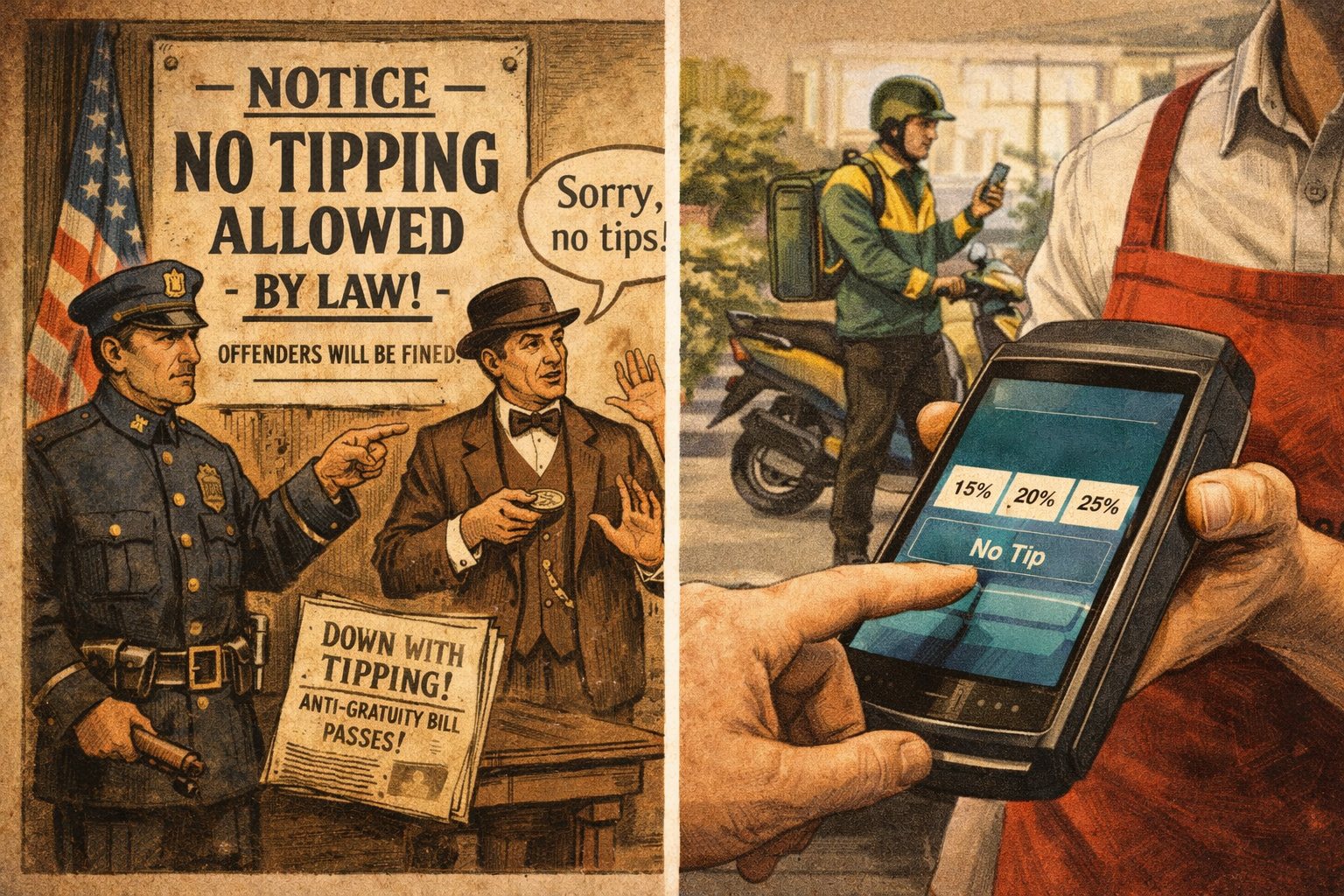
By the early 1900s, several states attempted to ban tipping altogether. Anti-tipping laws were introduced in places such as Washington, Tennessee, South Carolina, Mississippi and Arkansas.
Most of these laws appeared between roughly 1909 and 1915, and some even made it illegal to give or receive a tip.
The argument at the time sounds remarkably familiar today:
If businesses need staff to provide a service, they should pay them properly rather than relying on customer generosity.
The laws ultimately failed. Within a decade most had been repealed after strong lobbying from the hospitality industry, which argued tipping had become essential to their business model.
Over time the practice became normalised, and eventually deeply embedded in the American hospitality model.
How Tipping Spread Again
Fast forward a century and tipping appears to be expanding again, but this time through a different mechanism.
Not through social tradition, but through technology and payment design.
Modern payment systems make it incredibly easy to introduce tipping prompts.
Point-of-sale terminals now routinely present customers with preset options:
- 10%
- 15%
- 20%
Declining sometimes requires navigating additional screens.
Delivery platforms go even further, asking customers to tip before a service has even been provided.
What began as a voluntary thank-you is increasingly shaped by software.
The Platform Effect
This shift matters because the systems driving it are global.
Companies designing payment terminals, delivery apps and digital ordering systems operate across multiple countries. Once tipping prompts become embedded in those systems, they can spread quickly into cultures that historically treated tipping very differently.
In effect, tipping norms can now scale at the same speed as the technology that delivers them.
And when enough people encounter those prompts, behaviour begins to change.
What Can Actually Be Done?
If tipping culture is spreading through incentives and payment design, the uncomfortable reality is that the levers available to individual customers are fairly limited.
Consumers can decline default tipping prompts when they feel inappropriate.
They can ask businesses whether tips actually go to staff.
They can support restaurants that advertise transparent “service included” pricing.
But these actions only work at the margins.
The deeper forces shaping tipping today sit elsewhere — in labour models, platform economics and payment technology.
In other words, the behaviour is no longer shaped purely by etiquette.
It is increasingly shaped by software.
A Curious Irony
The tipping debate often gets framed as a cultural clash between different countries.
But the history suggests something more complicated.
Europe once exported tipping culture.
America embraced it.
Then tried to ban it.
Now the model appears to be spreading globally again, not through etiquette, but through technology.
What began as a social custom has gradually become a structural feature of modern service economies.
Further Reading
If you’d like to explore some of the history and economics behind tipping culture in more depth, these pieces are worth reading:
- National Geographic, Americans have hated tipping almost as long as they’ve practiced it https://www.nationalgeographic.com/history/article/tipping-history-united-states
- HistoryLink, Anti-tipping law, first in the nation, takes effect in Washington state at midnight on June 8, 1909 https://historylink.org/File/22487
- Richmond Fed, Tipping: From Scourge of Democracy to American Ritual https://www.richmondfed.org/publications/research/econ_focus/2024/q1_q2_economic_history
- NPR, When Tipping Was Considered Deeply Un-American https://www.npr.org/sections/thesalt/2015/11/30/457125740/when-tipping-was-considered-deeply-un-american
A Question Worth Asking
Tipping began as a voluntary gesture of appreciation.
Over time, it evolved into something more structured.
And today it is increasingly being shaped by the design of the systems we use to pay.
The real question may not be whether tipping itself is good or bad.
It may simply be this:
Are we choosing to tip…
or are we being quietly trained to?

 www.muckypaws.com