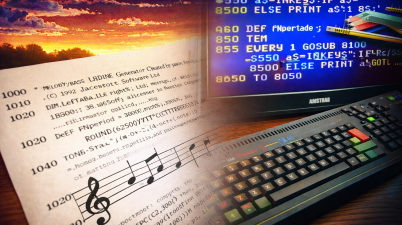
A look back at a 1992 Locomotive BASIC utility I wrote while converting Money Matters from the BBC B to the Amstrad CPC. What began as a quick and dirty way to encode an arrangement of Fiddler on the Roof into three-channel sound turned into a small music compiler, using note parsing, CPC sound periods, and interrupt-driven playback to keep the menu music running smoothly in the background.

A stunning procedural dragon created in just 10 lines of BBC BASIC for the BASIC10 Liner Competition 2026. After discovering Bazzargh’s clever use of trigonometry and plotting, I converted the code to the Amstrad CPC — proving that even 40-year-old machines can produce something truly striking from pure maths.
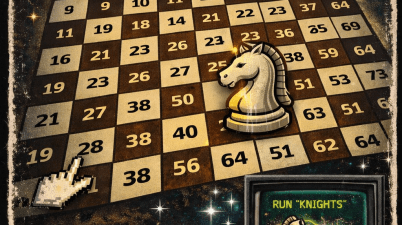
A look at my first entry into the 2026 BASIC10 Liner Competition for the Amstrad CPC: a Knight’s Tour solver written in just 8 lines of Locomotive BASIC. Using Warnsdorff’s heuristic, the program solves a centuries-old chess puzzle in real time while drawing the board, rendering a knight graphic, and displaying each move on screen.
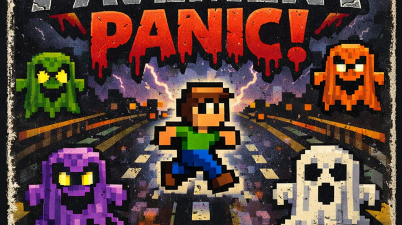
My second entry into the 2026 BASIC10 Liner Competition is Pavement Panic, a fast-paced ghost-dodging survival game for the Amstrad CPC written in just 10 lines of BASIC. Inspired by simple road-crossing games, it starts gently, then quickly turns chaotic as the ghosts speed up and survival time becomes your score.
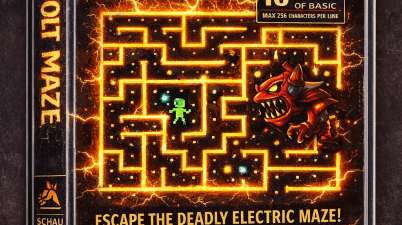
Voltmaze is my third entry into the 2026 BASIC10 Liner Competition… a procedurally generated maze game for the Amstrad CPC written in just 10 lines of BASIC. Inspired by classic 8-bit design and powered by a stack-driven depth-first search algorithm, it’s a small game with surprisingly sharp teeth… electrified walls, flickering hazards, roaming hunters, and a new maze every level.
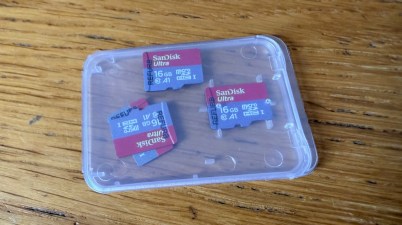
Cheap storage can come at a hidden cost. In this post, I explore the risks of fake and refurbished SD cards, how fraudsters manipulate capacity, and how you can test your storage on Windows, macOS, and Linux before trusting it with your data.

Bought during lockdown, forgotten in a box, found at the weekend. Getting the MHS35 3.5" TFT touchscreen working on Raspberry Pi OS Trixie (64-bit) is straightforward once you know the correct approach. The instructions in the box are out of date, the product page has been updated but leaves gaps around rotation and touch recalibration. This guide covers the complete setup from fresh Trixie install to a correctly oriented and calibrated display, including what the installer script actually does under the hood and why.

After exploring the idea of the Tipping Escalation Ladder, one question kept appearing: can tipping culture actually be reversed? Surprisingly, the United States once tried to ban tipping entirely. This follow-up looks at the forgotten anti-tipping movement of the early 1900s and how modern payment systems and delivery platforms may now be reshaping tipping expectations once again.

A modern payment terminal asking for a tip may look like a simple choice. But behind that screen sits decades of behavioural research, UX design, and subtle psychological nudges. As tipping prompts spread through global payment systems, the question becomes harder to ignore: are we choosing to tip… or being guided there by design?

Life in a six bed NHS bay means you don’t just witness other people’s behaviour… you live inside it. This is the tale of Rupert, a sports-obsessed, toilet-blocking, phone-call addict who managed to delay an entire surgical list, ignore antibacterial wash instructions, and still somehow be the main character on the ward.


 www.muckypaws.com